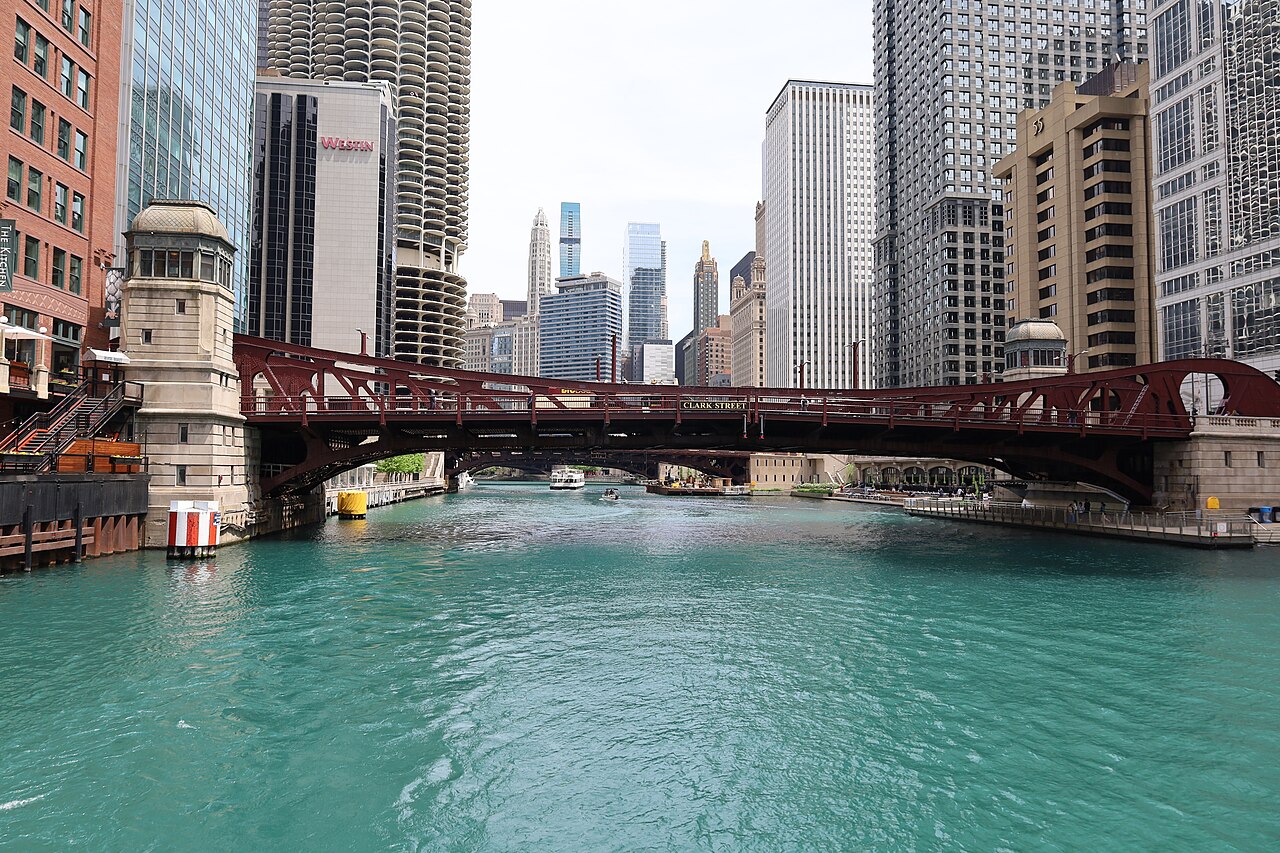
In a short stretch of river, repeated crossings make small design differences unusually visible. At Clark, focus on the curve of the steel and the way it frames the city beyond.
History
A floating bridge crossed here in 1840, followed by several swing bridges. Fire and rebuilding reshaped the crossing before the current bridge opened in July 1929. Replacing the final swing bridge on the Main Stem removed a type whose central piers had occupied valuable channel space.
How it works
Curved pony trusses rise beside the roadway without an overhead cross-frame. Bridgehouses stand at the northwest and southeast corners, with an architectural family resemblance to the nearby LaSalle crossing. Two leaves rise from the banks to clear the river.
What to notice
- The curved lines of the pony trusses
- Bridgehouses at diagonally opposite corners
- The clear channel without a central swing pier