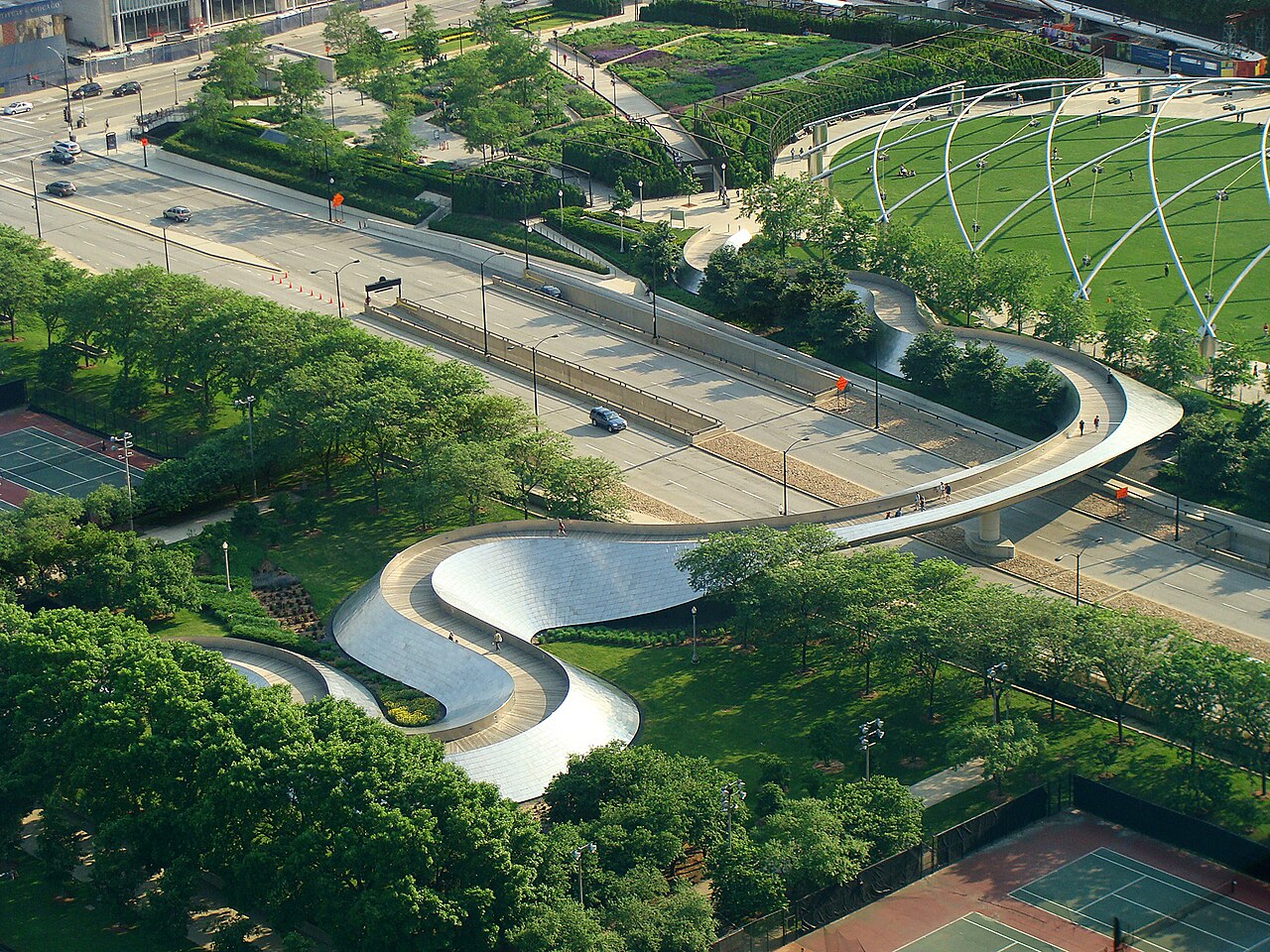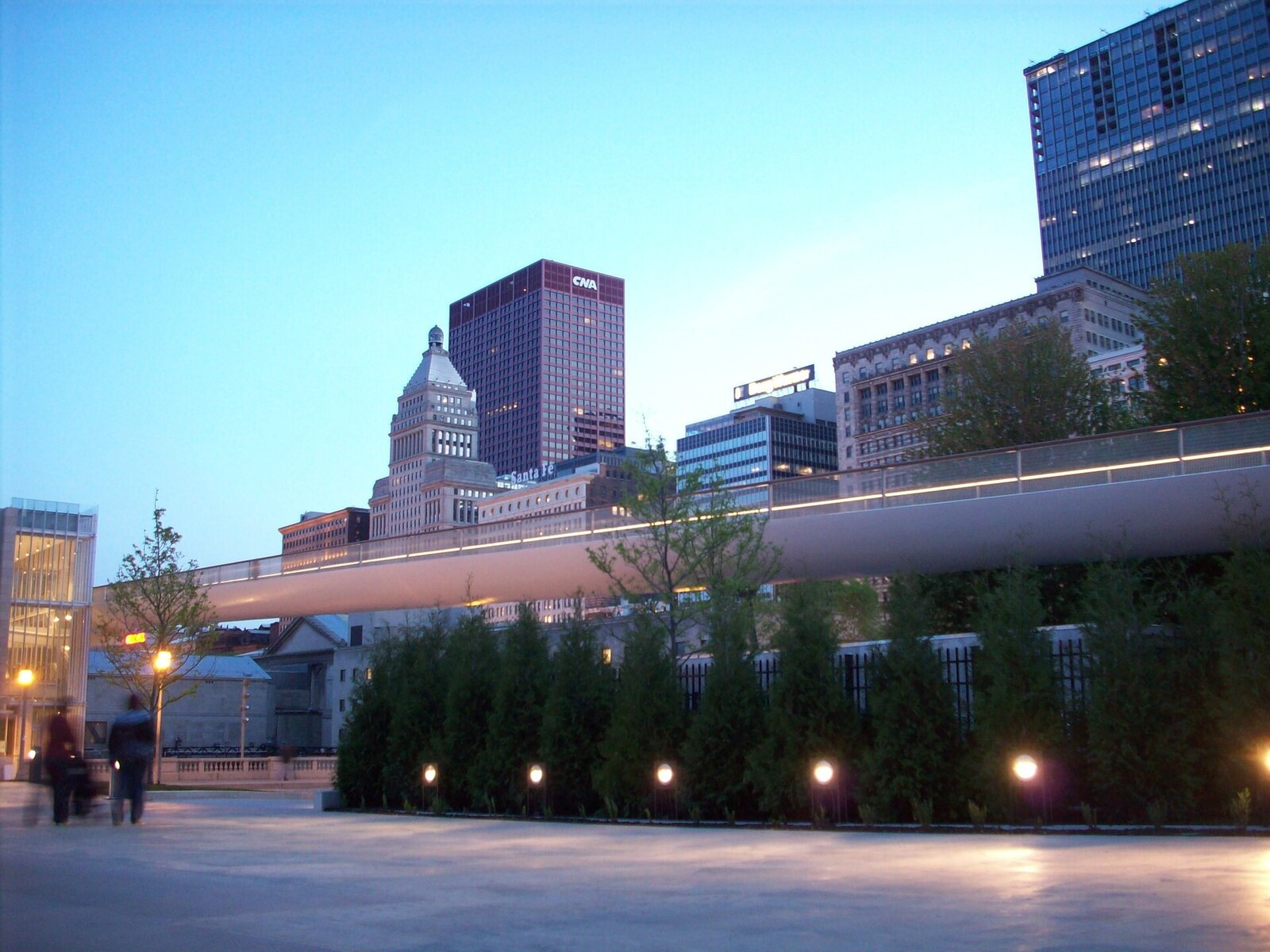
Nichols Bridgeway makes a city street disappear beneath a long, rising walk. From Millennium Park, its white deck points toward the Art Institute’s Modern Wing, treating the journey between park and museum as part of the architecture. The contrast with Frank Gehry’s nearby BP Bridge is striking: one wanders through a landscape, while the other draws a remarkably direct line toward a building.
History
The bridge opened in 2009 with the Modern Wing. Renzo Piano Building Workshop designed both as a connected project, bringing the museum into a closer relationship with Millennium Park. The bridge reaches the wing at its third-floor level, so it is as much an elevated entrance as a way across Monroe Street. Its identity belongs to that larger transformation of the Art Institute, rather than to the history of Chicago’s movable river crossings.
How it works
The approximately 620-foot steel structure keeps its depth deliberately shallow. Arup engineered the superstructure, with Wiss, Janney, Elstner Associates responsible for the substructure. A long incline gains the height needed to clear Monroe Street and meet the museum. The narrow profile is the main architectural effect: supports and deck work together to make a substantial crossing read as a thin white blade. Views change with the climb, opening back toward the park and skyline.
What to notice
- The unusually thin white edge above Monroe Street
- The long incline toward the Modern Wing
- The contrast with the curves of the nearby BP Bridge